
A uPVC door that has dropped is usually sagging on its hinges, or the glass inside it has slipped and pulled the door out of square. Both can often be put right without a new door. A door that only sticks on hot afternoons is usually reacting to the heat rather than broken. A new door becomes the better spend when the frame has twisted, the door keeps dropping after being adjusted, or the lock has failed more than once.
That is the short version. The rest of this article goes through how to tell which problem you have, what can be done about each one, and the one mistake that turns a stiff door into a locked out household.
How do you tell if a uPVC door has dropped?
A door that has dropped has sunk slightly on its hinge side, so the far edge, where the handle is, sits lower than it should. The signs tend to arrive together:
- The bottom corner on the handle side catches or scrapes on the threshold as it closes.
- The gap around the door is wider at the top on the handle side than at the bottom.
- You have to lift the handle harder, or further, than you used to before the key will turn.
- There is a draught or a line of daylight at one top corner.
- The key turns easily with the door open but is stiff with it shut.
That last one is the most useful test there is. Open the door, lift the handle and turn the key, the way you would to lock it. If everything moves smoothly with the door open but binds when it is closed, the lock is fine. The problem is that the hooks and rollers along the edge of the door are no longer lining up with the keeps on the frame, which is what a dropped door does.
Why do uPVC doors drop?
A uPVC door is a heavy thing hanging off one edge, and over years of use something gives. The usual causes:
- The hinges. They wear, the screws loosen, and a door that is slammed or caught by the wind puts a lot of strain on them.
- The glass has shifted. Inside the door, the glass or panel sits on small plastic packers placed at opposite corners, which hold the door square. If they slip or were never set right, the door slowly sags towards one corner.
- The frame has moved. Loose fixings, or slight movement in the wall, can pull the frame itself out of true.
- The heat. Strictly that is not dropping, but it looks the same, and it gets its own section below.
Is it the door, or is it the heat?
uPVC expands when it warms up, and the darker the colour, the more sunlight it soaks up and the more it moves. Doors facing south or west, which take the afternoon sun full on, see the most of it. A door that opens and locks perfectly in the morning and sticks on a sunny afternoon is very likely just expanding. The trade press has pointed out that the problem is worst where materials that move at different rates are joined together, such as a dark door in a white frame.
If that is the pattern, cooling the door down with a damp cloth usually frees it, and it will behave again once the sun is off it. Resist the urge to adjust a door during a heatwave. Set it up to close nicely when it is hot, and it may sit loose and draughty all winter.
What can be adjusted on a dropped uPVC door?
More than most people expect. Matching the symptom to the fix:
The door catches at the bottom
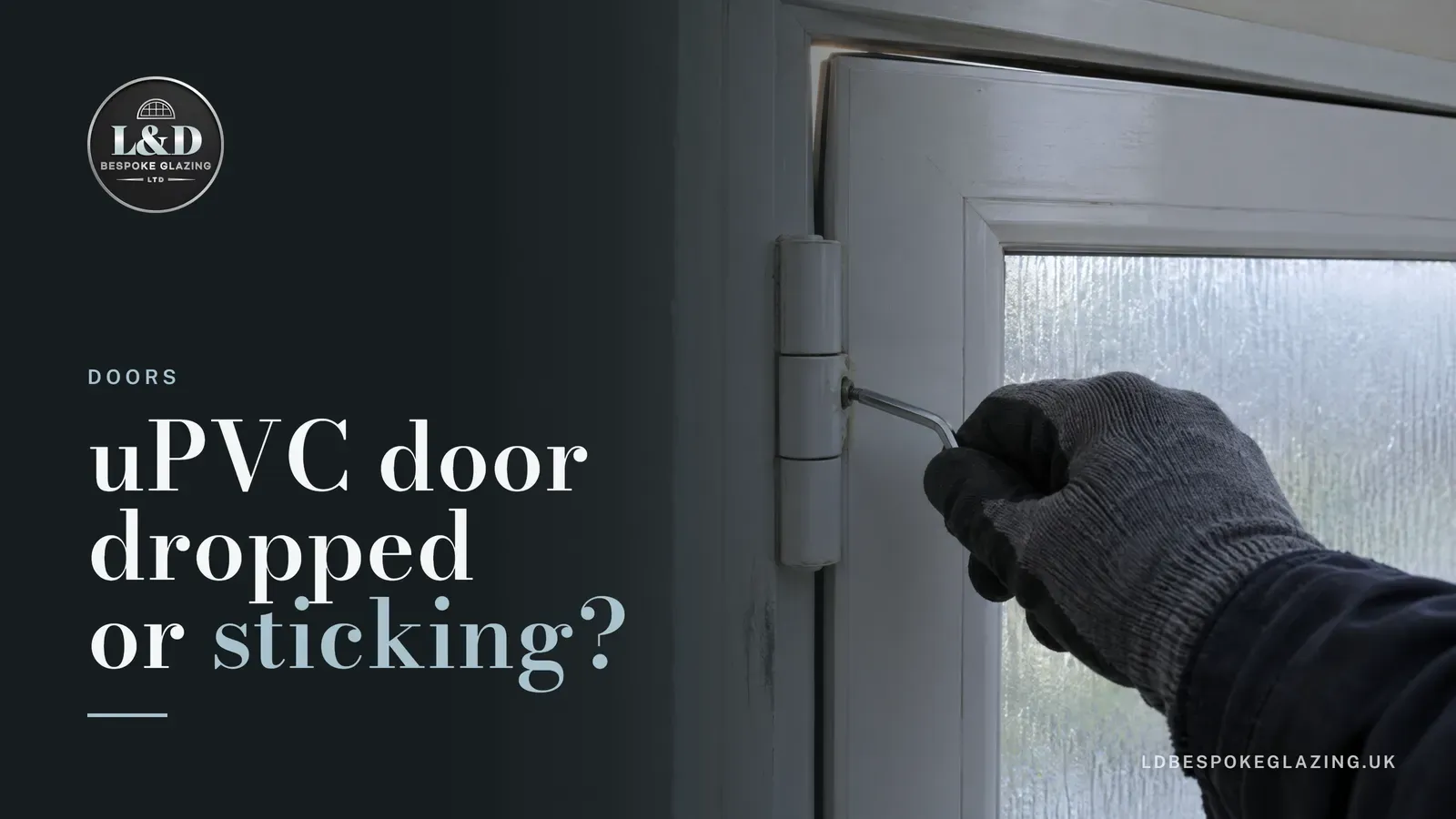
Many uPVC doors hang on flag hinges, which have adjusting screws hidden under small plastic caps. One screw raises or lowers the door, another moves it towards or away from the hinge side. Small turns, one hinge at a time, and check the door after each. If you are confident with an Allen key it is a job you can try yourself, using the hinge maker's instructions, but if the door is heavy or the screws will not move, leave it to someone who does it every day.
The door hangs straight but the lock is stiff
The keeps, the metal plates on the frame that the hooks and rollers engage with, can usually be moved slightly. Adjusting them is often all a stiff lock needs once the door itself is sitting right.
The door is out of square however the hinges are set
That points to the packers around the glass. Re-packing means taking the glass or panel out, setting the packers again and putting it back, which is a job for a glazier or a door repair firm rather than a weekend.
The handle has gone floppy, or will not lift the lock
That is usually the gearbox, the mechanism inside the door that the handle and key drive. A failed gearbox is replaced, not adjusted, and the new one has to match the old one's measurements exactly, so a locksmith will measure before ordering.
There is a draught but the door shuts fine
The rubber seals around the frame perish over the years, and they can be replaced on their own.
Why you should never force the handle
When a door has dropped, the handle starts to need more effort, and the natural thing is to push harder. Do not. Forcing the handle on a door whose locking points no longer line up is a common way for a gearbox to get broken, and a gearbox that fails in the locked position can leave you with a door that will not open at all. A door that is getting stiff is a door that needs adjusting now, while it is still a small job.
When is a new door the better spend?
Adjusting and repairing make sense on a door that is basically sound. They make less sense when:
- the frame itself has twisted or bowed, so the door can never sit right in it
- the door drops again within months of being adjusted, every time
- the hinges have no adjustment left in them
- the gearbox has failed before and is failing again
- the door panel has discoloured, cracked or started to come apart
- you never liked the door in the first place, and every repair is money spent keeping it
Add up two or three repairs on an old door and you are often a fair way towards a new one, which arrives with new hinges, a new lock, new seals and a frame that is square.
Do composite doors drop too?
Any door that hangs on hinges can need adjusting now and then, and composite doors are no exception. They are built differently, around a solid core rather than a hollow plastic frame, which keeps the door itself rigid. They are also heavier, so the hinges matter, and a dark composite door in strong sun still expands like anything else. A good one, fitted properly, should not need much more than the occasional small adjustment.
If your door is past saving, a new composite door takes Luke and Dale a day to fit, old door and frame out, new door set in, and the opening finished. They fit across Barnsley, Rotherham and the rest of South Yorkshire, and they come out, measure up and give you a price first. Ring 07487 719666.